What Does Building Carbon Audit Reporting Really Cost in Hours?
Building carbon and energy audit teams lose hours every year to collecting building data, re-entering it into calculation tools, writing reports and following up with clients. Enter your team size, weekly hours lost and the value of an hour in the calculator below to see the yearly total.

An audit report is only as quick as the data behind it. Floor areas, system details, meter readings, bills and photos arrive from different places, and every number has to be found, entered and checked before any calculation starts. This page helps you put a number on that time, using your own figures.
01. What a normal audit week looks like
On Monday, a building survey produces notes, photos and a folder of utility bills. On Tuesday, the key figures are typed into a spreadsheet, and the missing ones are requested from the client. On Wednesday, the same figures are entered into a calculation tool, and one is corrected after it is found to be in the wrong unit. On Thursday, the report is written, and the tables and charts are rebuilt in the template. On Friday, the draft goes to the client, and a follow-up is needed because nobody has replied.
None of that needs an assessor's judgement. All of it takes an assessor's time. When several audits run together, the reporting grows faster than the site work.
Four time-sinks account for most of it:
- Collecting building data. Notes, readings, bills and requests for missing information.
- Re-entering it into calculation tools. The same figures typed in more than once, sometimes in different units.
- Writing the report. Tables, charts and descriptive text assembled by hand from the results.
- Client follow-up. Chasing replies, comments and sign-off.
02. What automation and AI can take over
Most of these steps are handoffs: data moving from a survey to a spreadsheet, a calculation and a report. Handoffs can be connected without replacing the tools the team already uses.
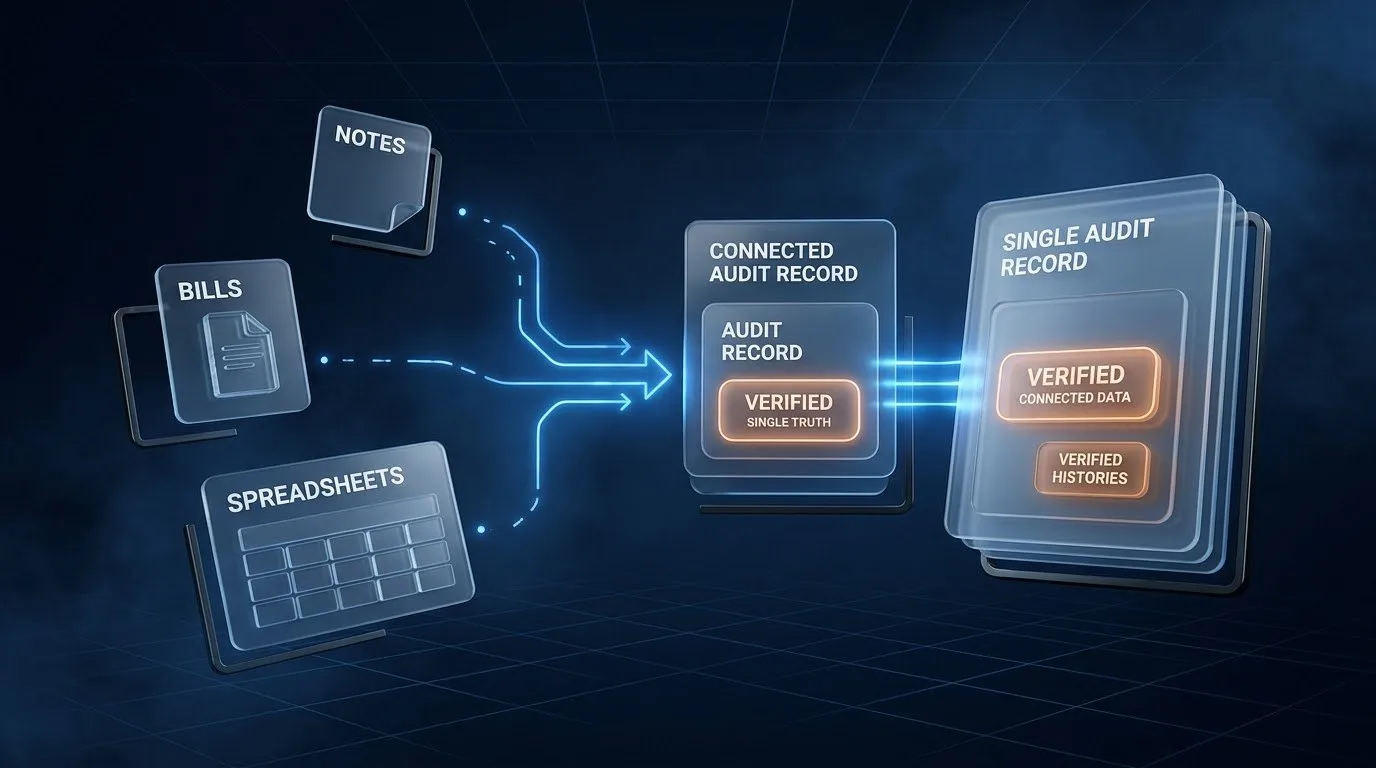
- Building data can be captured once, on a phone, into a single record for the audit, with units checked at the point of entry.
- Calculations can run from that record, so figures are not retyped.
- The first draft of a report can be assembled from the record, the results and the template. AI can help summarise notes, draft descriptive sections and flag missing or unusual data. The assessor reviews and signs the report.
- Client replies and sign-off can be tracked in one place, with who, what and when.
Some things stay with people: the judgement about what the numbers mean, the recommendations, and the conversation with the client. The aim is to remove the retyping and the chasing, not the assessor. For a worked example of a data-to-report pipeline, see the energy audit reporting pipeline.
03. Calculate your audit team's number
Carbon Audit Reporting Console
Building Energy & Carbon AssessorsBased on 46 working weeks a year. Cautiously models 50% recovery. Estimate based on your inputs; not advice.
04. How to use it
- Enter how many people are involved. Count everyone who collects data, runs calculations or writes reports, even part of the week.
- Enter hours lost per person per week. If you are unsure, ask each person to note the minutes for one week and take the average.
- Enter what an hour is worth. Use a charge-out rate, or your best estimate of the value of an hour of their time.
The result updates as you type. Choosing the biggest time-sink is optional. It does not change the numbers. It is only passed along if you decide to book a conversation.
An example. An audit team of four people loses eight hours each per week, and an hour is worth €75. A team of four people losing eight hours each per week to audit reporting loses 1,472 hours a year. At €75 an hour, those 1,472 hours are worth €110,400 of team time, not €110,400 of cash. If about half could be recovered, the team gets back 736 hours, or 92 working days.
These are example numbers, not an Irish average. Time freed from reporting becomes income only when there are audits waiting to use it.
05. What a lead can see when the systems connect
When building data, calculations, drafts and client replies sit in one connected workflow, a lead can see every audit's position without a status meeting. Which audits are waiting for data, which for calculation, which for review and which for the client. How long each has waited, and with whom. Each person sees what their role needs, and each step leaves a record.
That view changes planning. A lead who can see the queue assigns work earlier, and the team spends less time answering "where is that audit?".
06. Frequently asked questions
How is the yearly total worked out?
Hours a year = people × hours each per week × 46 working weeks. Cost a year = those hours × the value of one hour. The recovered figure is half of both, shown in hours, euros and working days (recovered hours divided by 8).
Why 46 working weeks?
It allows for holidays and leave. It is an assumption. If your team works more weeks, the real total is a little higher.
Why only about half?
Because no workflow removes everything. Half is a deliberately cautious assumption. Your real figure depends on how your audits are run, which a conversation about one workflow can clarify.
Does the calculator store what I enter?
No. The calculation runs in your browser and the result appears without an email address or login. If you choose to book a conversation, only the headline numbers and your optional time-sink choice travel with the link.
What counts as an hour lost?
Time spent on the four tasks above that does not need professional judgement: collecting data, re-entering it, assembling reports and following up with clients.
Can AI run the carbon calculations?
It can help check inputs and flag unusual values. The calculation method and the conclusions remain with the assessor, who reviews and signs the result.
Do we have to replace our calculation tools?
No. The estimate assumes you keep the tools you use and remove the manual steps between them.
What happens in the free 30-minute fit call?
You bring one workflow and the number you calculated, and we talk through where the hours go and what could be connected.
07. Next step
Hot path: Bring one workflow and the number you just calculated. Book a free 30-minute fit call →
Soft path: Print your result or copy the link to share with a colleague. Nothing is stored, and no email is needed.