How Much Time Do Commercial Cleaning Contracts Spend on Checklists and Reports?
Commercial cleaning companies lose hours every year to site checklists, inspection reports, rotas and client updates. Enter how many supervisors handle the paperwork, their weekly hours and the value of an hour in the calculator below to see the yearly total.

The cleaning is done at night or early morning. The paperwork follows in the day: the checklist, the report, the rota change, the message to the client. This page helps you put a number on it, using your own figures.
01. What a normal week looks like
On Monday, a supervisor visits four sites and fills in a checklist at each one. On Tuesday, the checklists are turned into reports, and photos are matched to the right site. On Wednesday, two cleaners are off sick, and the rota is rebuilt by phone and message. On Thursday, a client asks about a missed area, and someone searches through notes to answer. On Friday, invoices are prepared per contract, and each one is checked against the agreed schedule.
None of that is cleaning. All of it takes a supervisor’s time. As the number of sites grows, the paperwork grows with it, and each contract has its own requirements.
Four time-sinks account for most of it:
- Site checklists and inspection reports. Forms filled in on site and written up again afterwards.
- Rotas and cover. Rebuilding the plan when someone is off.
- Client updates and complaints. Searching for the answer, then writing it.
- Invoicing per contract. Checking each invoice against the agreed schedule.
02. What automation and AI can take over
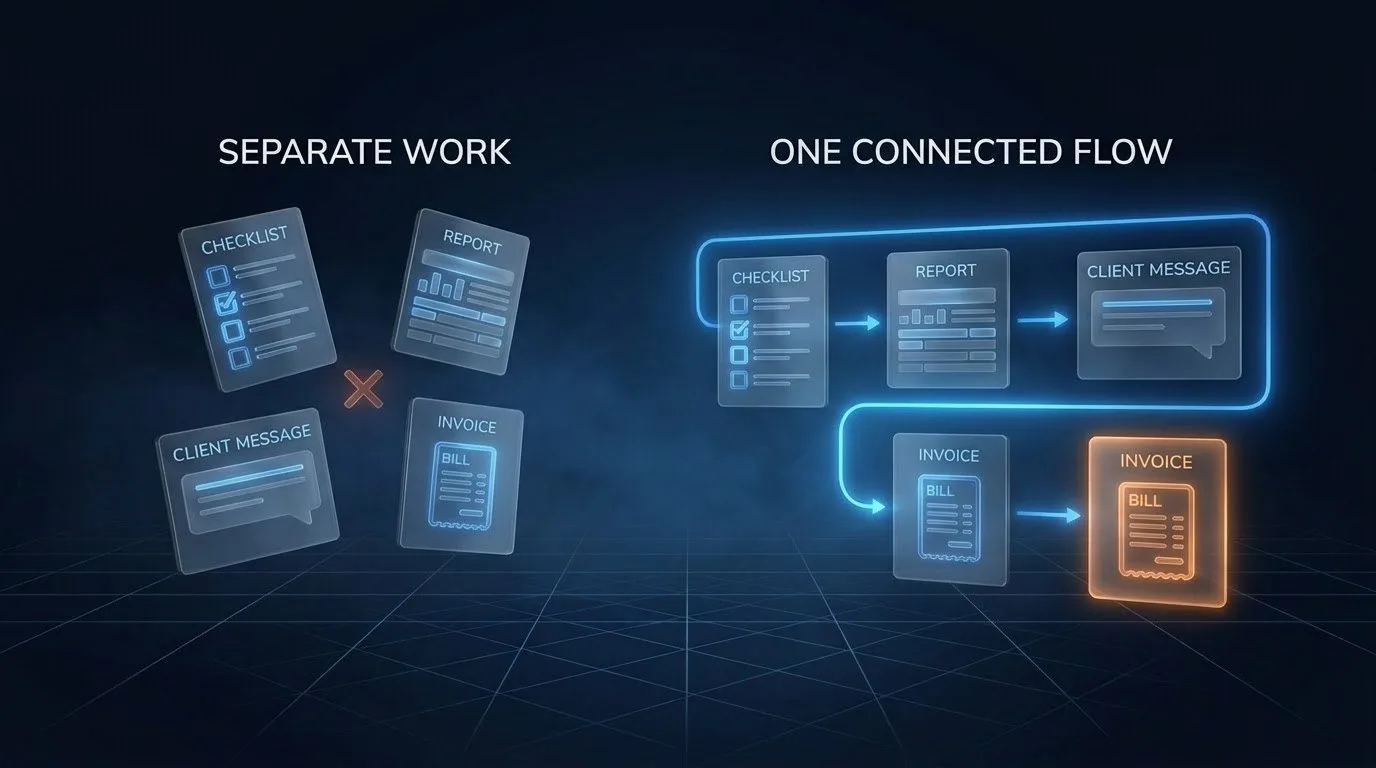
Most of these steps are handoffs: the same information moving from a site visit to a report, a client message and an invoice. Handoffs can be connected without replacing the tools already in use.
- A checklist can be completed on a phone on site, with photos attached to the right site and date, and turned into an inspection report without retyping.
- Cover messages can be sent from the rota to the people who are available, instead of by phone one at a time.
- Complaints and queries can be logged in one place, so the answer is found in seconds. AI can help draft a reply or summarise a history. The supervisor approves the message.
- Invoices can be prepared from the contract schedule and the completed visits.
Some things stay with people: the standard of the work, the judgement on site and the relationship with the client. The aim is to remove the retyping and the searching, not the supervisor. For why the small repeated tasks do the most damage, see the “just this one file” syndrome.
03. Calculate your company’s number
Cleaning Contract Paperwork Console
Site Checklists, Rotas & Supervisor HandoffsBased on 46 working weeks a year. Cautiously models 50% recovery. Estimate based on your inputs; not advice.
04. How to use it
- Enter how many people do the paperwork. Include the owner if the owner handles rotas or client calls.
- Enter hours per person per week. If you are unsure, note the time for one week, including evenings.
- Enter what an hour is worth. Use what that time costs you, or your best estimate of its value.
The result updates as you type. Choosing the biggest time-sink is optional. It does not change the numbers. It is only passed along if you decide to book a conversation.
An example. A company with two supervisors loses eight hours each per week, and an hour is worth €25. A company with two supervisors losing eight hours each per week to site paperwork loses 736 hours a year. At €25 an hour, those 736 hours are worth €18,400 of supervisor time, not €18,400 of cash. If about half could be recovered, the company gets back 368 hours, or 46 working days.
These are example numbers, not an Irish average. Paperwork time becomes income only when there is work waiting to use it, such as more sites to supervise.
05. What an owner can see when the systems connect
When checklists, reports, rotas, complaints and invoices sit in one connected workflow, an owner can see every site’s position without asking. Which sites have been inspected, which are overdue, and which have an open complaint. Which invoices are ready. Each person sees what their role needs, and each step leaves a record of who did what and when.
That view changes the week. An owner who can see all sites on one screen spots a problem earlier, and supervisors spend less time answering “how is that site doing?”.
06. Frequently asked questions
How is the yearly total worked out?
Hours a year = people × hours each per week × 46 working weeks. Cost a year = those hours × the value of one hour. The recovered figure is half of both, shown in hours, euros and working days (recovered hours divided by 8).
Why 46 working weeks?
It allows for holidays and leave. It is an assumption. If your company works more weeks, the real total is a little higher.
Why only about half?
Because no workflow removes everything. Half is a deliberately cautious assumption. Your real figure depends on how your contracts run, which a conversation about one workflow can clarify.
Does the calculator store what I enter?
No. The calculation runs in your browser and the result appears without an email address or login. If you choose to book a conversation, only the headline numbers and your optional time-sink choice travel with the link.
What counts as an hour of paperwork?
Time spent on checklists, reports, rotas, client messages and invoices that does not need a supervisor’s skill. Time spent supervising on site does not count.
Can AI write client updates?
It can draft a reply from the site history. A supervisor reads and approves it before it is sent.
Do we have to replace our current software?
No. The estimate assumes you keep the tools you use and remove the manual steps between them.
What happens in the free 30-minute fit call?
Its one purpose is to decide whether a paid Diagnostic is justified. It does not map your workflow or produce a roadmap, and it works best if someone who runs the workflow joins.
07. Next step
Hot path: Bring one workflow and the number you just calculated to a fit call. Book a free 30-minute fit call →
Soft path: Print your result or copy the link to share with a colleague. Nothing is stored, and no email is needed.