
Why We Don’t Quote Without a Diagnostic
A fixed price is only honest when it rests on a measured baseline. A Diagnostic maps one workflow end to end, quantifies where expert time and margin go, and defines acceptance criteria in writing, so the later price and the later promise can both be checked.

“Just give me a number” is a reasonable request. Most buyers have been burned by a quote that turned out to be a guess, and a reviewer in finance or procurement is right to ask for the figure first. This article explains why we answer with a Diagnostic before a price, what it measures, what it costs, and what you are protected by if it does not prove its worth.
01. What a fixed price needs
A fixed price is honest only if three things exist first: a defined scope, a measured baseline and written acceptance criteria. Without a baseline, the price is a guess dressed up as a number, and neither side can hold the other to it.
A baseline answers questions that a quote cannot: how long the work takes today, where the time and margin actually go, and what “better” would be measured against. Without it, any later claim of success or failure is an opinion.
02. What the Diagnostic measures
The Diagnostic is a standalone engagement on one named workflow. It covers five things:
- One named workflow mapped end to end. Every step and handoff, as it really runs.
- Time and margin leakage quantified. Where expert time and margin go today.
- A measured baseline established. The figures everything afterwards is compared against.
- Acceptance criteria in writing. What “done” means, agreed before any build.
- A decision document you own. What was found, and what to do about it.
The decision document is yours whether or not you go on to a build.
03. What it costs, and what it is not
The Diagnostic starts from €3,000. It is not deducted from the build fee, and it is not a free fit call. It is a piece of work with its own deliverable.
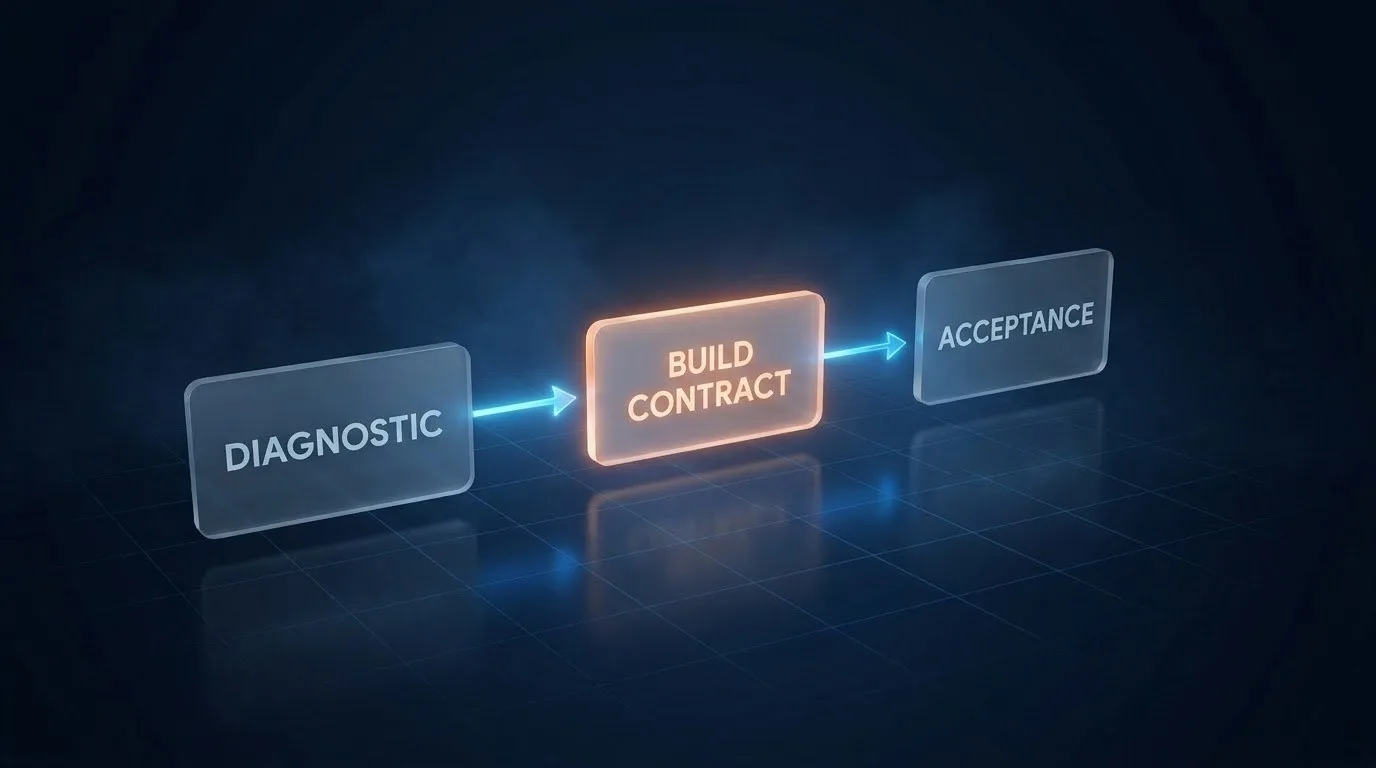
If the work continues, the usual sequence is the Diagnostic, then a Connected Delivery System build, then, if wanted, managed operations. A complete first workflow typically starts with the Diagnostic (from €3,000) followed by the build (from €10,000), depending on the final scope determined during the Diagnostic.
04. How the fixed price follows
After the Diagnostic, the build is priced against the baseline, in writing. Three terms matter to a finance reviewer:
- Two separate contracts. The Diagnostic and the build are not bundled, so the decision to build comes after the Diagnostic is finished and the scope is agreed, not before it.
- Three payments on the build. Forty per cent at signing, thirty per cent at a milestone and thirty per cent at acceptance. The final payment falls due only once the acceptance criteria agreed at the Diagnostic are met.
- Overruns are ours. Overruns caused by our own estimation are ours to absorb. Changes of scope, delays on your side and third-party issues go through written change control before the work is done. For how that works, see change control without surprises.
05. The assurance on the Diagnostic
If the Diagnostic cannot evidence recoverable value worth at least three times its own fee, calculated from data and assumptions agreed with you in advance, it is not charged. The threshold is set before the work starts, not judged afterwards. The mechanics are explained in the Diagnostic guarantee.
06. What you own
You own your data, your content and the bespoke outputs built for you. We keep our frameworks, methods, reusable components and the underlying architecture. Handover is documented, and so is the exit path.
07. The usual objections
“Can we skip the Diagnostic and go straight to a build?” No. A build priced without a measured baseline is one neither of us can hold the other to. The Diagnostic is what makes the fixed price, the acceptance criteria and the assurance possible.
“Can’t you estimate from a call?” We can describe the usual shape, as above. We cannot responsibly fix a price for a workflow we have not measured.
“Is the Diagnostic fee deducted from the build?” No. It is a standalone engagement that produces a decision document you own.
For how written acceptance criteria protect both sides, see written acceptance criteria vs. “looks right”. For the sequence of steps, see how it works.
08. Frequently asked questions
Why don’t you quote without a Diagnostic?
Because a fixed price without a measured baseline is a guess. The Diagnostic provides the baseline, the written acceptance criteria and the figures that make a fixed price and an assurance possible.
What does the Diagnostic measure?
One named workflow, mapped end to end, with time and margin leakage quantified and a measured baseline established.
Is the Diagnostic fee deducted from the build?
No. It is a standalone engagement that produces a decision document you own.
What happens if the Diagnostic does not prove its value?
If it cannot evidence recoverable value worth at least three times its own fee, calculated from data and assumptions agreed in advance, it is not charged.
Who owns what is produced?
You own your data, your content, the bespoke outputs built for you and the decision document. We keep our frameworks, methods, reusable components and underlying architecture.
Can we skip the Diagnostic?
No. Without a measured baseline, neither side could hold the other to the price.
09. Next step
See the terms in full. Pricing →