
How Many Hours Do Irish Plumbers and Heating Firms Lose to Quotes and Job Paperwork?
Plumbing and heating firms lose hours every year to writing quotes, filling in job sheets, invoicing and rescheduling jobs. Enter how many people handle the paperwork, their weekly hours and the value of an hour in the calculator below to see the yearly total.

The work is on the tools. The paperwork happens afterwards, at the kitchen table, once the van is parked. This page helps you put a number on those evening hours, using your own figures.
01. What a normal week looks like
On Monday, three quotes need writing, and each one starts from a blank page. On Tuesday, a callout pushes two booked jobs to Thursday, and someone rings round to rearrange them. On Wednesday, a job finishes, and the job sheet and photos sit in a phone until the weekend. On Friday, invoices go out, and the ones from three weeks ago still need a reminder.
None of that is plumbing. All of it takes the time of someone who could be on a job or at home. When the firm grows beyond a couple of vans, the paperwork grows faster than the work.
Four time-sinks account for most of it:
- Writing quotes. Starting from scratch, checking prices, sending, and waiting for an answer.
- Job sheets and photos. Notes and pictures that have to be matched to the right job.
- Invoicing and chasing payment. Typing the invoice, sending it, and following up.
- Booking and rescheduling. Phone calls and messages to rearrange the diary.
02. What automation and AI can take over
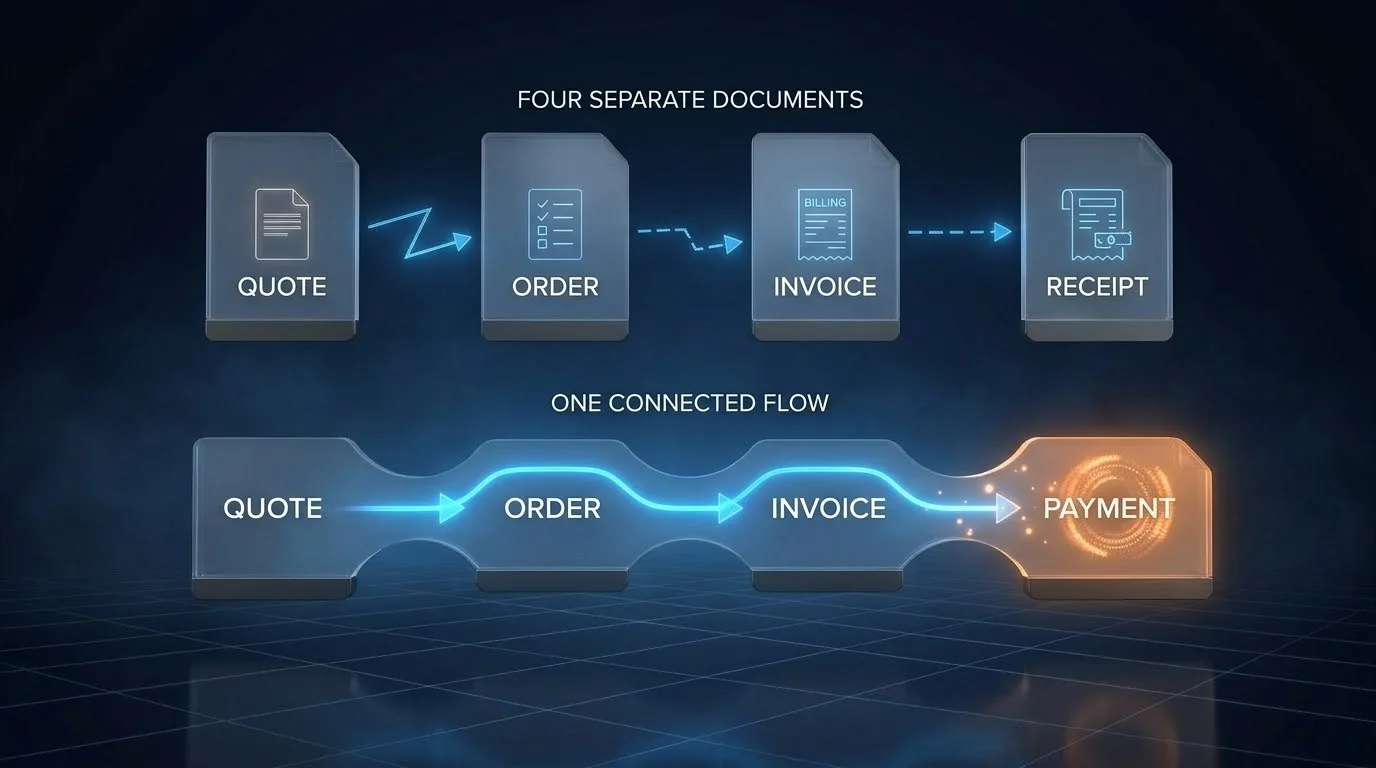
Most of these steps are handoffs: the same information moving from a quote to a job, from a job to a sheet, from a sheet to an invoice. Handoffs can be connected without replacing the tools already in use.
- A quote can be built from a template for the type of job, with the price checked by a person before it is sent.
- An accepted quote can become a booked job and a job sheet automatically, with the customer details already filled in.
- Photos and notes can be attached to the right job at the time they are taken.
- A completed job can produce the invoice, and payment reminders can go out on a schedule.
- Rescheduling messages can be sent from the diary instead of typed one by one.
Some things stay with the plumber: pricing judgement, the diagnosis on site, and the conversation with the customer. The aim is to remove the retyping, not the tradesperson.
03. Calculate your firm’s number
Plumber Paperwork Time Console
Quotes, Invoices & Scheduling HandoffsBased on 46 working weeks a year. Cautiously models 50% recovery. Estimate based on your inputs; not advice.
04. How to use it
- Enter how many people do the paperwork. Include the owner if the owner does it in the evenings.
- Enter hours per person per week. If you are unsure, note the time for one week, including evenings and weekends.
- Enter what an hour is worth. Use what you would charge for an hour on a job, or your best estimate.
The result updates as you type. Choosing the biggest time-sink is optional. It does not change the numbers. It is only passed along if you decide to book a conversation.
An example. A firm of three people loses seven hours each per week, and an hour is worth €60. A firm of three people losing seven hours each per week to paperwork loses 966 hours a year. At €60 an hour, those 966 hours are worth €57,960 of time, not €57,960 of cash. If about half could be recovered, the firm gets back 483 hours, or about 60 working days.
These are example numbers, not an Irish average. Paperwork time becomes income only when there are jobs waiting to use it.
05. What an owner can see when the systems connect
When quotes, bookings, job sheets and invoices sit in one connected workflow, an owner can see every job’s position without phoning the van. Which quotes are waiting for an answer. Which jobs are booked, in progress or finished. Which invoices are out, and which are overdue. Each person sees what they need, and nothing depends on someone remembering to tell someone else.
That view changes the day. An owner who can see the whole board plans the week earlier and spends less time on the phone asking where things stand.
06. Frequently asked questions
How is the yearly total worked out?
Hours a year = people × hours each per week × 46 working weeks. Cost a year = those hours × the value of one hour. The recovered figure is half of both, shown in hours, euros and working days (recovered hours divided by 8).
Why 46 working weeks?
It allows for holidays and time off. It is an assumption. If your firm works more weeks, the real total is a little higher.
Why only about half?
Because no workflow removes everything. Half is a deliberately cautious assumption. Your real figure depends on how your firm works, which a conversation about one workflow can clarify.
Does the calculator store what I enter?
No. The calculation runs in your browser and the result appears without an email address or login. If you choose to book a conversation, only the headline numbers and your optional time-sink choice travel with the link.
What counts as an hour of paperwork?
Time on quotes, job sheets, invoices, chasing payment and rescheduling that does not need a tradesperson’s skill. Time on site does not count.
Can a quote really be automated?
A first draft can be built from a template for the type of job. A person still checks the price before it goes out.
Do I have to replace the software I already use?
No. The estimate assumes you keep the tools you use and remove the manual steps between them.
What happens in the free 30-minute fit call?
Its one purpose is to decide whether a paid Diagnostic is justified. It does not map your workflow or produce a roadmap, and it works best if someone who runs the workflow joins.
Related: The “just this one file” habit
07. Next step
Hot path: Bring one workflow and the number you just calculated to a fit call. Book a free 30-minute fit call →
Soft path: Print your result or copy the link to share with a business partner. Nothing is stored, and no email is needed.